
You did everything right. You got the diagnosis, followed the protocol, and for a few glorious weeks your belly was flat and you remembered what it felt like to eat without bracing for the bloat.
Then it crept back. So now you’re standing in the supplement aisle, or scrolling online, wondering: which supplements for SIBO actually work, and which are a waste of money?
You’re in the right place. In this guide, we’ll walk through the five categories of supplements used in a SIBO protocol, what the research says about each, and why the order and timing matter as much as the products themselves.
Let’s dive in!
First, Why Supplements Alone Don’t Fix SIBO
SIBO (small intestinal bacterial overgrowth) happens when bacteria that belong mostly in the colon overgrow in the small intestine, ferment food too early, and cause bloating, gas, distension, constipation or diarrhea, and fatigue.
It also has a very high relapse rate. In one study of 80 patients whose breath tests normalized after antibiotics, SIBO returned in about 13% by three months, 28% by six months, and 44% by nine months (1). Recurrence was more likely with older age, a history of appendectomy, and chronic use of acid-blocking medication (1).
That’s because killing bacteria is only half the job. SIBO returns when something lets the bacteria regrow, and many underlying risk factors have been identified (2). The most common are:
- A sluggish migrating motor complex (MMC), the cleansing wave your gut runs between meals to sweep bacteria downstream (3)
- Low stomach acid or digestive insufficiency, with acid-suppressing medications linked to higher SIBO risk (4)
- Thyroid issues, since hypothyroidism is associated with SIBO (5)
- Adhesions or structural changes from past abdominal surgery
- Past gut infections, which emerging research suggests can impair motility (6)
The right supplements target these root causes as well as the overgrowth. If you’re unsure which applies to you, schedule an assessment here and we’ll investigate.
The 5 Categories of Supplements for SIBO
Here’s the framework I use, organized into three phases (eradicate, repair and restore, relapse prevention) and six layers:
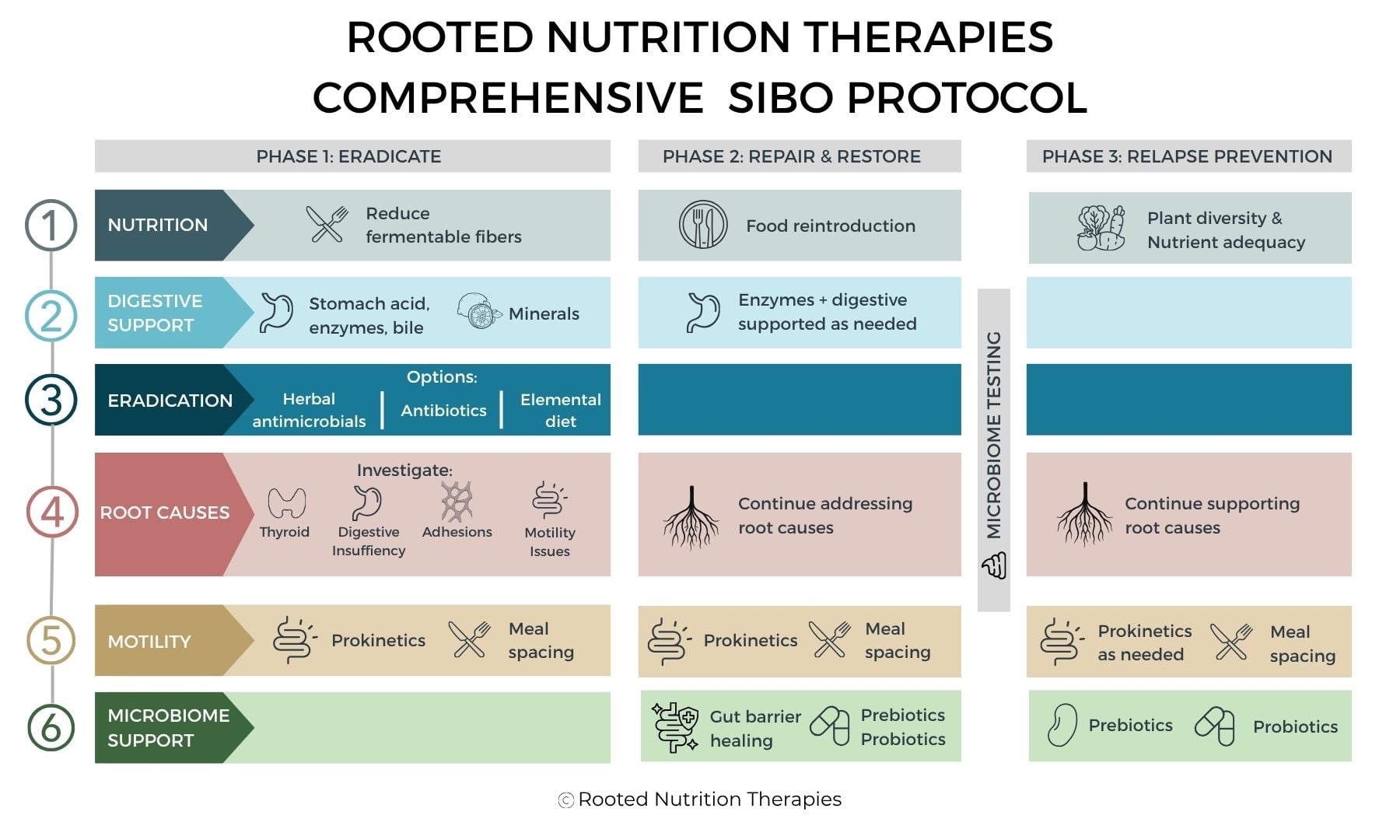
The supplements fall into five categories:
- Herbal antimicrobials
- Digestive support
- Prokinetics for motility
- Gut lining support
- Prebiotics and probiotics
Let’s go through each one.
1. Herbal Antimicrobials: To Reduce the Overgrowth
What they do: Reduce bacterial overgrowth in the small intestine. This is where most people start, and where the research is most developed.
The evidence: The best-known study included 104 patients with a positive breath test. After treatment, 46% of those who took herbal therapy had a negative breath test, compared with 34% on rifaximin, which was not a statistically significant difference (7). Among people who didn’t respond to rifaximin, 57% responded to herbal therapy as a rescue, compared with 60% who responded to triple antibiotics (7).
The caveats matter: the study was retrospective, patients chose their own treatment, it used two different multi-herb formulas, it didn’t separate hydrogen from methane SIBO, and both approaches helped fewer than half of patients (7).
Commonly used herbs:
- Berberine. One of the most-used SIBO herbs, now being tested head-to-head against rifaximin in a registered randomized trial (8).
- Oregano. Often included in multi-herb formulas for broad antimicrobial activity.
- Thyme. Another common formula ingredient.
- Neem. Frequently used alongside other antimicrobials.
- Allicin. A compound from garlic used without the fermentable carbohydrates found in whole garlic.
Most of the human evidence comes from combination formulas, not single herbs. This is also the approach I tend to use in my practice.
Hydrogen vs. methane matters. Hydrogen-dominant SIBO tends to cause bloating and diarrhea. Methane-dominant overgrowth (intestinal methanogen overgrowth, or IMO) is driven by archaea rather than bacteria and tends to cause constipation. Different types of SIBO tend to respond better to different types of herbs. This is why testing before you start a protocol matters.
2. Digestive Support: To Fix the Conditions That Let SIBO Grow
What they do: Replace what’s missing in digestion so bacteria stay where they belong and food moves along.
Common options:
- Digestive bitters to stimulate production of digestive juices
- Betaine HCl with pepsin to support stomach acid
- Digestive enzymes to help break down food
- Bile support (such as ox bile) for fat digestion
Important: These aren’t for everyone. Betaine HCl isn’t safe for people with ulcers or regular NSAID use, and not everyone with SIBO has low stomach acid. This is one of the clearest reasons to use testing and guidance instead of guessing.
3. Prokinetics: The Relapse-Prevention Supplements
What they do: Support the MMC, your gut’s built-in cleansing wave, so bacteria don’t build back up.
If I could underline one category in this article, it would be this one. Impaired motility is one of the most common reasons SIBO returns.
Common options:
- Natural prokinetics, such as ginger-based formulas
- Prescription prokinetics, which your physician can discuss with you
- Meal spacing, a free tool. Leaving a few hours between meals and a long break overnight gives the cleansing wave time to run (3).
Many people need motility support for months, not weeks.
4. Gut Lining Support: To Repair After the Overgrowth
What they do: Support the intestinal barrier that overgrowth and inflammation can stress.
Common options:
- L-glutamine
- Zinc carnosine
- Immunoglobulins
- Demulcents, like slippery elm and marshmallow root
These are commonly used in the repair phase of a protocol. Because we know that SIBO causes inflammation and can impair nutrition absorption, healing the gut lining after a SIBO protocol is a key step in relapse prevention.
5. Prebiotics and Probiotics: To Rebuild the Microbiome
What they do: Replenish and feed beneficial bacteria once the overgrowth is under control.
The evidence: A meta-analysis of 18 studies found that probiotics improved SIBO eradication rates and abdominal pain, but did not prevent SIBO (10).
Why timing matters: Many people feel worse on standard high-dose probiotics during active overgrowth, because adding live bacteria to a crowded small intestine can make symptoms worse. That’s why probiotics work best added in sequence, often using spore-based strains, and why prebiotics (like partially hydrolyzed guar gum) are introduced gradually. If you’ve taken a probiotic and felt more bloated, that’s useful information, not a failure.
Not a Supplement, but Worth Knowing: The Elemental Diet
An elemental diet is a short, supervised, liquid-only plan that starves the overgrowth. In a study of people with IBS and abnormal breath tests, 80% normalized after 14 days and 85% after up to 21 days (12). It’s intense and not right for everyone, but it’s one option when herbs or antibiotics haven’t worked.
Common Mistakes with SIBO Supplements
- Taking antimicrobials without addressing motility or root causes. This is the most common reason for relapse.
- Starting a probiotic first. Rebuilding before the overgrowth is addressed can set you back.
- Piling on supplements without testing. More bottles doesn’t mean a better protocol.
- Not Testing. Without testing, you’re guessing about what your gut needs and what worked.
Why Work with a Practitioner
It’s tempting to order a bottle of berberine and call it a day. But the right protocol depends on your gas type, your root causes, your medications, and how your body responds. A practitioner can:
- Choose the right supplements and sequence them
- Adjust dosing safely, since some herbs interact with medications or other supplements
- Address motility and root causes alongside eradication
- Ensure your nutrition plan is adequate to support your gut
- Retest and adjust so you aren’t treating blindly
Supplements are tools. The plan is what makes them work.
Final Thoughts
The best supplements for SIBO aren’t a single product. They’re a sequence: reduce the overgrowth, support digestion and motility, repair the lining, and rebuild the microbiome, while investigating why SIBO developed in the first place.
Furthermore, supplements will not fix everything for you. SIBO impairs nutrient absorption and restricted diets can leave your microbiome like a barren wasteland. Re-nourishing your body with the right nutrition is also required in order to re-build your gut after SIBO.
As a Registered Dietitian also board certified in Integrative and Functional Nutrition, I can guide you through a SIBO supplement protocol and also help you optimize your nutrition in every phase of the journey.
You don’t have to live with unpredictable bloating. A root-cause protocol can give you lasting freedom, not another short-term fix.
Ready to stop the cycle? Click here to schedule your assessment, or learn more about our Nourish & THRIVE Functional Healing program.
This article is for educational purposes and isn’t medical advice. Work with a qualified practitioner before starting any supplement, especially if you take medication or are pregnant or breastfeeding.